


Recently, China Mobile, China Unicom and China Telecom have announced the results of the first half of 2019. In the media report, the words “earn 400 million per day” have once again swayed the nerves of netizens.
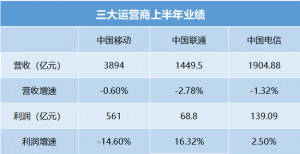
The first half of the three major operators
But in fact, in the first half of this year, the three operators all fell into the growth bottleneck without exception, and collectively, the overall revenue fell year-on-year. What is more serious is China Mobile. Even the three indicators of revenue, communication service revenue and net profit have declined at the same time, setting the worst performance in the past decade.
Behind this is the combination of the disappearance of traffic dividends, increased competition in the industry, and speeding up and lowering fees. Operators are also cultivating new growth drivers such as family business and government business outside of personal business, and promoting the optimization and transformation of their business structure.
The bigger opportunity is 5G. This not only means a new round of traffic dividends, but also an opportunity for operators to digitize the industry and further develop into 2B business. However, in the case that the business model is not very clear, the huge infrastructure investment in the early 5G period has increased the pressure on operators who have experienced financial crisis.
Growth dilemma
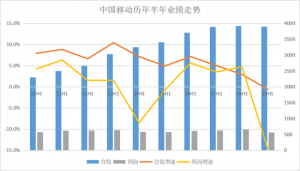
China Mobile first announced a bleak semi-annual report.
China Mobile’s semi-annual performance trend
According to the financial report, in the first half of 2019, China Mobile’s operating income was 389.4 billion yuan, down 0.6% year-on-year, of which communication service revenue was 351.4 billion yuan, down 1.3% year-on-year. More seriously, the profit attributable to shareholders of China Mobile was 56.1 billion yuan, down 14.6% year-on-year. It is the worst half-year performance since the listing in the past decade.
In fact, since 2010, China Mobile has also experienced a decline in profits in the first half of 2014 and the first half of 2015, but the decline of nearly 15% is extremely rare. At the same time, this is the first time since 2010 that China Mobile has experienced a year-on-year decline in revenue in the first half of the year.
From the specific data point of view, in the case of both mobile and 4G customers, China Mobile has seen a situation in which customer growth does not increase. Mobile Internet traffic revenue decreased by 1.5% year-on-year, and voice and short multimedia message revenue decreased by 20.6%.
Dong Hao, vice president and chief accountant of China Mobile, explained that on the one hand, the impact of speed reduction and the cancellation of traffic roaming charges last year, the overall income in the first half of the year decreased by 4.7 billion yuan, resulting in a profit decline of nearly 6%; On the other hand, rigid costs have increased, depreciation has increased by 4.2 billion yuan, marketing expenses have also increased, sales expenses have increased by 4.5%, and R&D investment in 5G vertical industries has increased. These factors have all contributed to the decline in China Mobile’s profits.
For China Unicom, its revenue for the first half of 2019 was 144.95 billion yuan, down 2.78% year-on-year, of which service income was 132.957 billion yuan, down 1.1% year-on-year; net profit was 6.88 billion yuan, up 16.32% year-on-year.
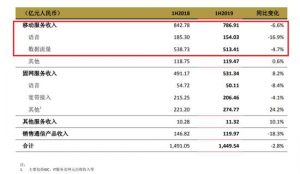
China Unicom’s revenue structure in the first half of the year
It is worth noting that China Mobile’s mobile service revenue also increased by 6.87 billion yuan, a year-on-year decrease of 6.6%. The voice revenue decreased by 16.9% year-on-year, and data traffic revenue decreased by 4.7% year-on-year. China Unicom said in its earnings report that it was affected by speed-up and fee reduction, market saturation, fierce market competition and the gradual decline of 4G traffic dividends.
China Telecom’s operating income for the first half of the year was 190.848 billion yuan, down 1.32% year-on-year; the company’s shareholders attributable profit was 13.909 billion yuan, up 2.5% over the same period last year.
Among China Telecom’s operating income, voice revenue declined year-on-year, but the growth in Internet revenue, information and application services revenue offset the decline in voice revenue.
Open source throttling
For the decline in revenue, operators first adopted a “throttle” to reduce costs and increase efficiency.
Taking China Mobile as an example, in terms of network cost, the average maintenance fee per base station decreased by 11.8%, and the average electricity cost per carrier frequency network decreased by 7.1%. China Mobile also carried out the clean-up of inefficient and invalid business hall stores to promote channel transformation. The number of self-operated halls was over 500, and the number of cooperation halls was over 1,200, which reduced the average sales cost per customer by 2.7%.
China Unicom implemented “Slimming Fitness 2.0”: the number of provincial and local companies decreased by 11% and 25% respectively; increased employee productivity and reduced demand for outsourced personnel; Income can increase or decrease. At the user level, strict user development costs and ultra-low tariff packages are strictly controlled.
China Telecom is to deepen the three-dimensional linkage reform of small contracting, inverted triangle support and professional operation, mobilize the enthusiasm of employees, promote management and small scale, and further reduce costs and increase efficiency.
In addition to “throttle”, operators are more focused on “open source.” For the decline in revenue, all three operators mentioned in the financial report that the traditional communication business is facing saturation factors, and expanding the emerging business is undoubtedly the focus of the future.
China Mobile is vigorously promoting the reform of the government and enterprise operation system. In the financial report, it officially announced the establishment of the government and enterprise division based on the government and enterprise branch. China Mobile said that it will build the government and enterprise market into a new kinetic energy growth and transformation and upgrading main force. In the first half of this year, China Mobile’s government and enterprise market revenue was 44.558 billion yuan, accounting for 12.5%, making it the second largest source of revenue for China’s mobile communications services. China Mobile also proposed a full-year target of 10 million yuan for government and enterprise customers.
Another focus is on cloud services. China Mobile has established a cloud capability center based on the Suzhou R&D Center, and even proposed to enter the first camp of domestic cloud service providers within three years; at the same time, China Mobile has also established a smart family. The operation center strengthens the smart home business and establishes the headquarters international business department to accelerate the reform of internationalization.
China Unicom has increased its investment in government and enterprise customers and the industry Internet.
In the first half of 2019, China Unicom’s government and enterprise customer income was 46.2 billion yuan, a year-on-year increase of 14%. Industrial Internet revenue was 16.72 billion yuan, a year-on-year increase of 43%. Among them, cloud computing revenue was 1.1 billion yuan, up 166.8% year-on-year; big data income was 530 million yuan, up 128.2% year-on-year; Internet of things income was 1.4 billion yuan, up 43.3% year-on-year; IT service revenue was 5.44 billion yuan, up 73.7% year-on-year; IDC revenue was 8.24 billion yuan, a year-on-year increase of 18.7%.
With the help of mixed reforms, China Unicom has also established a number of joint ventures with its partners to deepen business cooperation. For example, it has established a joint venture company, Yunjing Wenlv, to launch a series of smart travel products, and established a joint venture company with Ali to develop smart products such as urban brain and smart government.
China Telecom has also strengthened its layout in home and government and enterprise customers. In the first half of this year, Tianyi HD users reached 111 million, intelligent gateways and household cloud users were 61.8 million and 32.15 million respectively; DICT and IoT services together boosted service revenue by 3%, of which IDC and cloud business revenue increased by 11% and 93.2%, Internet of Things revenue increased by 52% year-on-year; Internet financial revenue increased by 112.2%.
5G opportunities and challenges
In addition to promoting the optimization and transformation of its business structure, the major opportunity for operators is 5G.
Xu Zhijun, vice chairman of Huawei, said in public that there are two major needs in the Chinese market in the 5G era: eMBB and industry digitalization. He believes that 5G will increase the production efficiency of smart medical and smart industries by 10 times. In the industry digitalization, operators are expected to rely on 5G to seize the opportunity.
According to the financial report, China Mobile will build more than 50,000 5G base stations during the year to achieve 5G commercial services in more than 50 cities. China Unicom plans to build more than 40,000 5G base stations in 40-50 cities this year, focusing on new media and industrial internet. Key industries such as transportation, education, medical care, and cultural tourism will create typical 5G application scenarios; China Telecom plans to carry out SA/NSA hybrid networking in about 50 cities in the early stage, achieving scale coverage in key urban areas, and striving for In 2020, the network upgrade for SA will be launched.
But 5G commercials also pose great challenges for operators. Ke Ruiwen, chairman of China Telecom, admits that the network evolution and business model of the 5G era will face new challenges.
In terms of business model, operators have not yet specified the charging rules for 5G packages. It is reported that China Unicom and China Telecom will carry out the function package in the early stage. The minimum package is 190 yuan per month and 199 yuan per month. This has even triggered a rebound of some netizens, shouting “too expensive to use”.
However, in fact, due to the early issuance of 5G commercial licenses, it has also brought pressure on capital expenditure to operators to a certain extent, not to mention the fact that the business model is not yet fully understood.
In the financial report, China Unicom put forward the 5G construction strategy of “accurate and efficient on-demand investment”, saying that it will be invested in dynamics according to technological progress, market and business needs, and at the same time, on-demand rolling arrangements for 2B demand with good business model. It can be seen that it is relatively cautious in the construction of 5G.
At the China Unicom performance conference, Wang Unichu, chairman of China Unicom, also said that China Unicom will not carry out 5G construction in all places in the future. At present, China Unicom is seeking cooperation with China Telecom and China Mobile. There are two possibilities for follow-up cooperation. Corresponding mode: Either cooperate with China Telecom, rely on the advantages of the two 5G frequencies, build and share, operate separately, reduce maintenance costs; or cooperate with China Mobile in roaming mode. China Unicom prefers key areas and areas with large traffic coverage to cover 5G, and the rest of the region allows China Unicom users to use 5G services through China Mobile roaming.
Ke Ruiwen, chairman of China Telecom, also said at the performance conference that he has reached a high consensus with China Unicom on joint construction of 5G networks and is willing to negotiate with other operators including China Mobile.
