


When the United States repeatedly attacked Huawei, American companies and the US media expressed their concerns to the Trump administration. Bloomberg said on the 25th that blocking Chinese companies such as Huawei may cause the United States to “fire”, and US companies such as Microsoft and General Electric have submitted written comments to the US Department of Commerce expressing concern about Washington’s ban on Chinese companies.
Bloomberg’s article, “Trump’s restrictions on Huawei may be counterproductive to US technology,” said the Trump administration’s attempt to make China sell products or buy US corporate parts and services by banned some key Chinese companies. Slow down the pace of its technology. But Bloomberg believes that the Trump administration’s plan may be “burned out.”
Bloomberg said that Huawei seems to be in a leading position in the supply of 5G infrastructure, and the 5G issue also reflects most of Washington’s concerns. And cutting off the business of China’s technology giants, the United States will only slow down the pace of 5G development – which is undoubtedly bad news for some of the most important American companies. “Without China’s 5G network, Chinese consumers will not buy mobile phones with Qualcomm and Micron technology chips, and will not generate data that needs to be calculated with Intel, NVIDIA and AMD processors, nor will they need to pass Broadcom and Xilinx. Chips are getting faster on network devices,” Bloomberg said.
According to reports, US companies, including Microsoft and General Electric, worry that export controls that the US is considering may actually prevent them from competing in lucrative markets and weaken US innovation because of the technology involved in export controls. It is seen as the key to improving competitiveness.
In a written paper submitted to the US Department of Commerce, Microsoft warned that the proposed restrictions may isolate the United States from international research cooperation and “may harm the interests of the United States.”
GE also said in its report that the definition of too broad export controls may affect areas such as medical imaging. “Artificial intelligence is a very broad concept.”
“The more we continually confuse economic war with national security interests, the more we begin to see everything as national security,”said Evana, CEO of security software company Omelias. “When you hold it in your hand, When you hammer, everything looks like a nail.”
In addition to US companies, some experts expressed concern about the US ban. “I don’t think it’s good for the US economy,” said Zhao Mingyuan, an associate professor at the Wharton School of the University of Pennsylvania, who told Bloomberg that “a robust system has made the United States a long-term trusted force in the global supply chain. People are not always trust China, but they regard the United States as a trustworthy partner. If the supply chain can be vandalized, trust in the United States will disappear, and countries around the world will develop their own systems, with consequent inferior and more expensive goods and services.”
Goldman Sachs analysts even estimate that if China retaliates by banned Apple products, Apple may lose nearly a third of its profits. But for now, there is no indication that China will do so.
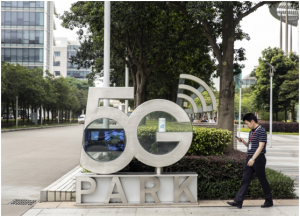
An employee walked past Huawei 5G Park signage
Chinese Foreign Ministry spokesman Lu Hao said on the 24th that for some time, individual US politicians have repeatedly made rumors about Huawei, but they have never been able to provide conclusive evidence from various countries. The United States has also raised more and more doubts about the US side provoking trade wars with China, market turmoil caused by science and technology wars, and blocked industrial cooperation. In this case, these American politicians continue to fabricate various subjective presumptions of lies to try to mislead the American people, and now they are trying to incite ideological opposition. To be frank, this is totally illogical. Looking at the world, ideological differences do not necessarily hinder economic, trade, industrial and scientific cooperation between countries.
Lu said that we have repeatedly stated China’s position on Huawei. We urge the US to immediately stop using the power of the state to suppress the enterprises of other countries, seek illegitimate interests, disrupt the market, and undermine international cooperation. China has consistently advocated the settlement of differences between the two countries, including economic and trade, through friendly dialogue and consultation. But all dialogue and consultation must be based on mutual respect, equality and mutual benefit. Only by following such principles can any dialogue be possible, hopeful and meaningful.
In addition, the US government has suppressed China’s private enterprise Huawei in the name of so-called security. This practice has been criticized by many countries in the world and people from all walks of life in the United States.
Recently, US investment adviser Ben Hanbo said in an interview with the US media that the US government’s suppression will not only achieve its purpose, but will accelerate the independent research and development of Chinese companies.
US investment consultant Ben Hanbo: Although China does not have such a good domestic chip industry, such an event in the past ten days (the suppression of Huawei) will accelerate China’s transformation. If the United States does not provide support in these areas, then they themselves will seek development in these areas. If we don’t give them, such as Huawei’s mobile phone, the operating system in the mobile phone, then they will develop their own operating system, and may eventually replace the US system.
US government behavior harms US investor interests
Ben Hanbo also said that many Chinese technology companies are investors from the United States, and the US government’s suppression of Chinese technology companies will harm the interests of US investors. He also reminded that Chinese companies are not lacking investors, and many investors outside the United States are interested in investing in Chinese technology companies.
US investment adviser Ben Hanbo: Look at the shareholding structure of them (Chinese technology companies) to know that many of the largest investors are venture capital firms, and most investors come from the United States. It is ironic that the shares of these Chinese technology giants are held by the majority of US investors. In the Middle East and Southeast Asia, many other investors are willing to take up this part of the responsibility, and they are interested in increasing their investment in the (China) market.
