



According to a report released by real estate consulting firm Cushman&Wakefield, the Asia Pacific region will invest $280 billion in data center expansion in the coming years, making it the fastest-growing data center market globally, second only to North America in terms of installed capacity.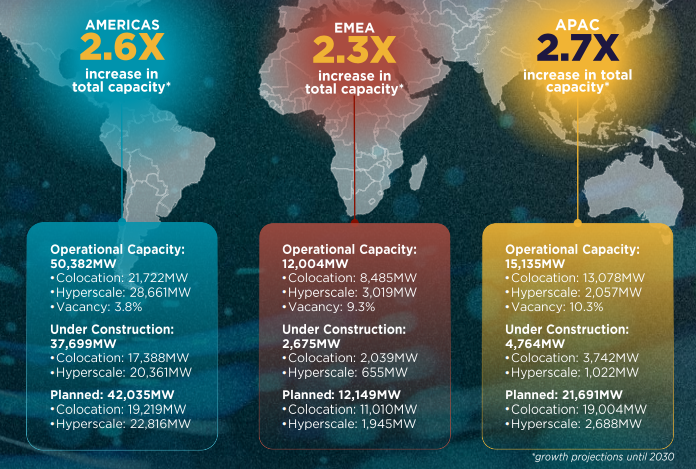
This region is also the most underserved market – with 60% of the global population but only 22% of data center operating capacity. Vietnam, the Philippines, and Indonesia are the most underserved countries among them. The report points out that despite the addition of 2200MW of hosting capacity in the past year, the vacancy rate has actually tightened, indicating that demand growth has exceeded supply growth. Another 22.7GW of managed capacity is under planning and construction, with strong pre-sale sales support, indicating that the industry will continue to grow in the next three to five years.
Government control measures
Unlike the growing wave of opposition faced by data centers in European and American countries, data centers in the Asia Pacific region have not encountered resistance of the same scale. Although there are occasional protests and concerns in the region, it is far from reaching the scale of the United States.
A new poll shows that 75% of Americans oppose the construction of data centers in their local area, with over 60% strongly opposing it. Data centers are likely to become a core campaign topic in the upcoming midterm elections. Although the public opposition to data centers in the European Union is not as intense, according to independent statistics, 70 projects have been rejected or restricted in the first quarter of this year.
One possible factor is that governments in the Asia Pacific region have taken measures in advance to limit environmental impacts. The Singapore government implemented a new construction ban as early as 2019 due to limited land supply and consumption of energy and water resources by data centers. The ban was lifted in 2022, and a proposal to build 80MW of new capacity was approved. On August 22, Digital Realty, Equinix, Keppel Data Centers, and ST Telemedia Global Data Centers were again approved to build an additional 200MW of capacity, requiring them to commit to using green energy for over 50% of their capacity. The Singapore government is also advancing a new digital infrastructure bill to further tighten environmental standards.
Johor, Malaysia – the center of the country’s data center boom – has suspended project approvals that do not meet electricity and water efficiency standards. After absorbing $36 billion in data center investment between 2021 and 2025, the state began implementing restrictive measures last year, including phasing out speculative investments. The Australian government announced last month a plan to require new data centers to provide clean energy and limit water usage, and is accelerating related legislation.
Data center demand continues to be strong
The report author points out that the sustained strong demand for data centers in the region is due to the fact that most governments have implemented restrictions on the industry, rather than allowing opposition to develop like in the United States. Nitin Soni, Senior Director of Infrastructure and Project Financing at Fitch Ratings, stated that in the Asia Pacific region, government restrictions are more focused on controlling the impact of data centers on the environment and infrastructure rather than opposing technology companies themselves.
He believes that “in the United States, the focus of public opposition is on the lack of transparency and participation of technology giants in local communities, while in Asia, we see more government led restrictions on land, electricity, and water resources”.
