


With the issuance of 5G licenses, China officially entered the 5G commercial year, and the 5G bearer network also entered the full commercial stage. Compared with the traditional bearer network, the 5G-oriented bearer network has undergone a series of major changes regardless of the basic performance such as bandwidth and delay, and the overall architecture of the forwarding, control, and management planes. How to build a bearer network covering the entire 5G lifecycle is an important challenge for the entire industry.
Analysis of 5G bearer technology
The 5G requirements for the bearer network are not only to provide large bandwidth, but also to support massive connections, differentiated guarantees for different services, and end-to-end network slicing capabilities. How to meet the basic needs of 5G bearers, and then combine the market, technology development trends, to analyze some of the focus issues.
Large bandwidth
5G wireless base stations use Massive MIMO, CoMP and high-order modulation technologies to greatly improve spectrum utilization efficiency, and increase the spectrum bandwidth by introducing a new air interface spectrum. Compared with the single-baseband bandwidth in the 4G era, the bandwidth is increased by several times. It is a consensus that the core of the 5G bearer network and the aggregation layer are built with 100GE and 200GE. After the technology matures and then expands to 400GE, the impact on the existing network is small, and the overall solution is cost-effective. At present, the focus is mainly on the optical modules of the access ring.
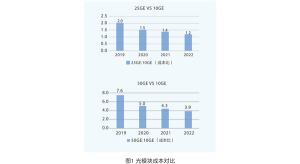
For 25GE and 50GE optical modules, we have conducted an in-depth analysis of the maturity of the industry chain (see Figure 1). There is no problem with the availability of optical modules, and the localization rate is also above 90%. Therefore, the choice of modules depends mainly on the network construction plan and cost. The requirements for the rigidity of the 5G access bandwidth are as follows: 50GE/100GE for C-RAN access and 25GE/10GE for D-RAN; the cost of the 25GE module is lower, and the cost of the 50GE module is relatively high. When the cost ratio of 10GE drops to about 4, large-scale deployment of the entire network is carried out.
Massive connection
The number of 5G north-south and east-west connections will increase by more than 10 times compared with the 4G era, and the application-driven connection is dominant, with high dynamic characteristics. Therefore, the bearer network needs to introduce a programmable network open capability, and implement separation of forwarding and control through SR (Segment Routing) to implement full-mesh full connection in the IGP area, introduce SDN to realize network connection controllable, and support cross-Rapid and on-demand networking of domain and cross-vendor massive network connections to meet the rich interconnection needs of 5G industry applications.
Currently, IPv6-based Segment Routing (SRv6) is a hot topic discussed in the industry. It is one of two basic schemes of SR; the other is MPLS-based Segment Routing (SR-MPLS). From the perspective of industry development, SR-MPLS is currently leading the industry. In comparison, in the forwarding plane, SR-MPLS has no special ASIC requirements, only specific SR-MPLS control plane software (software upgrade) is required; SRH6 adopts SRH as a new IPv6 header, which is special ASIC requirements. Therefore, the cost of adopting SR-MPLS is relatively low. The advantage of SRv6 is that operators can use the simpler IPv6 architecture to provide the same applications and services as the MPLS stack. Given that MPLS is a mature technology for operators, and IGP-based SR-MPLS further simplifies MPLS, SR-MPLS is still the mainstream choice in the near future. Considering that major changes in the carrier network will be a relatively slow process, SRv6 will gradually be accepted and deployed after both the standard and hardware chips are mature.
Business differentiation
The five service application scenarios of 5G have huge differences in service SLA requirements. The service QoS model of the bearer network must be transformed from the traditional “best effort” to bandwidth guarantee and delay guarantee to meet the needs of the vertical industry. At present, there are two main solutions in the industry. One is to introduce TDM-Like’s ultra-low latency and ultra-low jitter pipeline by introducing Ethernet channelization technology, and the other is to use TSN (Time Sensitive Network) technology. Relatively speaking, the Ethernet channelization technology is relatively mature and has been applied in the 5G bearer network. In the 5G bearer lab test organized by the operator, ZTE’s 5G bearer single-point forwarding delay is as low as 0.5μs, and the measured index is excellent, which can guarantee the low delay demand in the 5G era.
Network slice
The 5G network supports a variety of services. Various services need to be isolated to avoid mutual influence and ensure the security and robustness of the network. The requirements include soft isolation and hard isolation. Soft isolation mainly uses SR tunnels. Hard isolation includes FlexE sub-interface isolation and Ethernet slicing channels to form a VNet virtual network. The 5G slicing service is an end-to-end service chain. The bearer network needs to match the corresponding VNet topology according to the requirements of service chain and pipe isolation. Establishing a pipe connection for vertical industry services on the VNet topology to realize multi-use and high-security network.
Only the 5G bearer network with the above capabilities can really help the interconnection of all things in the 5G era, and serve thousands of industries.
Analysis of the characteristics of the new generation of bearer equipment
The key elements of the 5G bearer network equipment include capacity, power consumption, and security performance. Based on the development characteristics of the industry, ZTE is committed to building a 5G bearer that can cover the sustainable evolution of the 5G life cycle.
ZTE’s 5G equipment is based on a dual-T platform. The core aggregation equipment requires a single-line card with T-bit evolution capability; the access equipment has a total capacity of T bits, while the single-line card supports 400G evolution capability.
ZTE’s full range of 5G bearer self-developed chips, including T-level network processing of core equipment and custom ASIC chips for switching chips and access devices, leading performance and supply chain security. According to the overall power consumption analysis of the bearer equipment, the main business chip consumes 64% of the power consumption, so reducing the power consumption of the chip is crucial for energy saving. ZTE’s core equipment self-developed chip solution has a 48% reduction in power consumption compared to the outsourced chip solution.
In order to support the bearer of diversified services, 5G uses a large number of new technologies such as SDN/NFV, network slicing, and MEC to provide richer and more flexible network capabilities, which are important assets such as infrastructure connected to 5G networks and 5G networks. Bring new security threats and challenges. Therefore, security is a very important part of building a bearer network covering the entire life cycle of 5G. ZTE is one of the few manufacturers in the industry to fully build a security architecture. Through ISO information security and supply chain security certification, it provides safe process guarantee for the whole life cycle of products; self-developed CGEL operating system and ROSNG protocol stack platform and self-developed forwarding chip lay a solid foundation for product safety; The $10 million investment in safety tools, including white-box tools, black box tools, and penetration testing, is the product’s safety escort; it has an industry-leading safety laboratory that escorts product safety through this open, collaborative carrier.
Create a 5G intelligent bearer network with minimal operation and maintenance
The development of network intelligence can be roughly divided into four stages: traditional network, programmable network, intelligent network and autonomous network. With the development and application of SDN, big data and AI, the current bearer network has entered the programmable network stage, and some areas have moved to the intelligent network stage.
The 5G bearer network must have the ability to enter the intelligent network phase. This capability needs to be built separately from the forwarding layer, the control management layer, and the operational layer. If the network is likened to a car, then the forwarding layer is the wheel of the car, the control layer is the driving computer, and the operating layer is the engine.
In the forwarding layer, the simplified protocol, network slicing and Telemetry are combined to provide support for the network forwarding layer. In the management layer, through network simulation, traffic prediction and other means, the passive control is implemented, thereby realizing self-adjustment and self-networking of the network. Optimization and network self-healing, effectively improve the network’s control ability and simplify the operation and maintenance difficulty; at the operational level, it needs to be open to fully utilize the engine’s driving role.
ZTE proposed Athena bearer network smart solution. The solution consists of three main engines: automation control, intent-driven and network-aware. It is integrated with the forwarding device to achieve continuous integration, continuous delivery and continuous openness. The service issuance cycle is shorter, the time to market is faster, and the network operation and maintenance is greatly improved.
The ultimate goal of minimalist intelligent operation and maintenance is an autonomous network, which requires the industry to jointly promote network awareness, improve network decision-making strategies, and gradually realize unmanned autonomy of the network.
Building a manageable 5G bearer network
Looking back at the 4G period, the development of the cloud is obvious to all, and its business model is mature, which is a stable growth point of profit. The cloud in the 5G era will undergo tremendous changes, and the target of cloud services will shift from individuals and enterprises to vertical industry applications. MEC as a lightweight cloud node is everywhere, greatly expanding the coverage and depth of the cloud. Multi-level cloud interconnection, flexible service scheduling and management make the network supporting cloud connection in the 5G era more complicated than the 4G era. Therefore, the realization of the cloud network convergence, the network with the cloud, in order to play the best results. To this end, ZTE proposes to build a 5G bearer network concept that can be operated, using slice as a link, integrating cloud and network, providing differentiated services, and opening up network resources, making it an advantage and opportunity for operators. Slices are obviously an important tool to help operators add value. What capabilities do you need to slice in the 5G era?
– Fast deployment: Slices are distributed and recycled to the minute level, relying on intelligent management and control platform to respond to user needs in real time.
– Experience: In addition to ensuring bandwidth, low latency and jitter are also guaranteed. Based on the Sliced Channel technology, a high-quality deterministic network is realized to meet the demanding new business needs of cloud games and smart manufacturing.
– Detection: Through the introduction of new technologies such as InBand OAM and Telemetry, customers are provided with real-time sensing of slice quality to ensure user experience.
– Visualization: When customizing the service, the customer can visually see the quality of service of different slices through the orchestrator and choose the required service independently. This is a similar experience to planning different lines for navigation software in everyday life. Better implementation of cloud network convergence through minute-level on-demand deployment, low latency, high reliability, and visualized bearer tiling scheme; by virtualizing one network into N networks, responding to different subdivision scenarios and achieving “one network and one industry”, to help operators achieve added value.
Constructing a bearer network covering the entire life cycle of 5G is a system engineering. It is necessary to combine the end-to-end 5G network features to comprehensively design 5G bearer technology solutions and a new generation 5G bearer equipment. At the same time, it is necessary to create an intelligent network with minimal operation and maintenance. The network is operated to ensure the advancement and sustainable evolution of the network. It is believed that in the near future, the 5G bearer network will enable all things to be interconnected, combine slice management and highly intelligent operation and maintenance systems to provide differentiated services for 5G new services, realize network value-added, and help operators achieve commercial success.
