


On April 9th, the cloud computing service supplier Tencent teamed up with well-known module suppliers, transmission cables suppliers and test equipment vendors to launch 400G test of the earliest, the most comprehensive and the highest technical data center domestically in Yinke Building, Haidian District, Beijing which lasted a week.
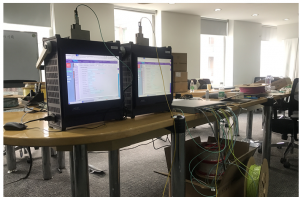 With the rapid growth of Internet traffic driving the data center to 400G evolution, the data center 400G all-round testing is of great significance. At present, North America is leading the market demand upgrade, and China’s data center is also rapidly following up. Internet content provider Tencent, as the main cloud computing service provider in China, will pass the 400G network test to understand the actual performance of 400G optical modules.
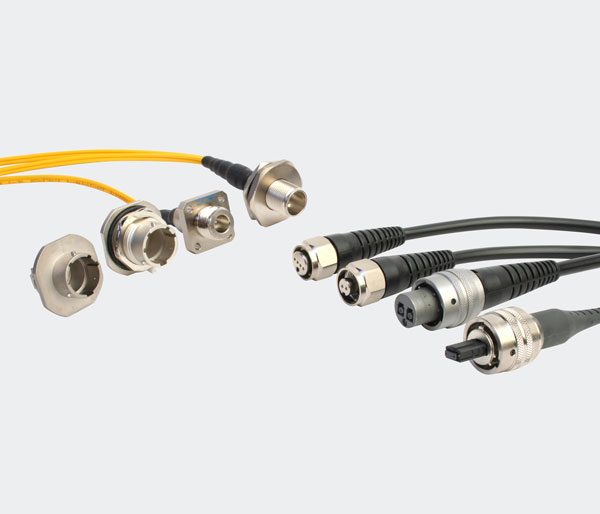
In this data center 400G network test, we can see Tencent use 400G TH3 32*400G interface switch, Viavi test equipment, Rosenberg full-type port transmission jumper, and a full range of 400G optical modules from well-known manufacturers. The simulated networking environment was used to test 400G networking from short distance 100m to long distance 10km, and tested various types of 400G light including 400G SR8/SR4.2/FR4/ /DR4/LR4 optical modules.
Dr. Sun Min, a senior expert at Tencent Network Architecture Center, said that Tencent’s 400G network test coverage covers all link distances in the data center and uses the industry’s most advanced test equipment and fiber transmission jumpers (including long-distance OM5 fiber) to test the mainstream. A full range of 400 modules from optical module manufacturers. The 400G optical module test mainly examines four indicators. One is whether the optical module network test has error codes and packet loss. The second is whether the pluggable optical module can respond quickly after installation. The third is the 400G optical module. The power dissipation is mainly focused on the loss performance in the standard temperature. The fourth is whether there is a problem with the docking of different manufacturers of 400G optical modules. At the scene, Tencent also conducted silicon optical module testing, and compared with traditional optical modules, Tencent prefers to use single-mode silicon optical modules.
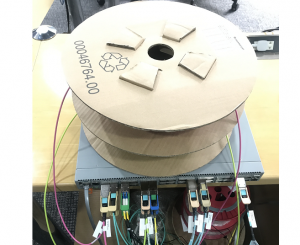
According to the results of the 400G module intercommunication test, Tencent believes that there are still some problems in the actual engineering application of the 400G optical module in the current stage. There are still insufficient performance and product consistency, and the interoperability of each manufacturer module is low. At the same time, various optical interface standard types also have an unnecessary impact on data center operator optical module selection. The Demo module intercom test can see some problems. The module single test is completely different from the networking test. For example, the error and performance relationship is not absolute. The 400G pluggable module needs to leave more margin to the switch and 400G optical module power consumption. The performance was lower than expected.
It is understood that the data center 400G optical module package form selection tends to QSFP-DD, but the interface standard is more complicated. Under the same transmission scheme, there are various interfaces, such as 400GBASE-SR8, the port has 16 cores and 24 cores. There are also APC and UPC end face types. Tencent experts said that the network test is designed to demonstrate the benefits of unified interface standards for practical use, and hopes to work together with the industry to promote the development of unified interface standards, which can reduce development costs for data center operators and optical module manufacturers. At the same time, Tencent’s switch expert Cheng Chuansheng believes that the interoperability and power consumption of optical modules are very important to the switch system, and the industry is expected to reduce the power consumption of optical modules.
In general, there are still many problems to be considered in the actual application of the data center 400G, such as fiber specifications, different interfaces matching different fiber types, and specific optical modules, such as SR8/SR4.2/FR4/DR4/LR4, require more testing. Tencent will have at least two rounds of networking testing in 2019. The next time it will pay more attention to environmental testing, it will use switches from different manufacturers, and the interface types will be more unified. Tencent hopes that the industry can further improve the consistency and stability of 400G optical modules. In terms of 400G commercial use, Tencent has some big data and high-performance computing scenarios. It is expected that there will be small batch deployments at the end of this year or the first half of 2020, and there will be some time from high-volume use.
