


Recently, European multinational telecommunications operator Vodafone officially launched commercial 5G networks in 15 cities such as Madrid and Barcelona in Spain. Spain has become a European country with 5G commercial networks after Switzerland, the United Kingdom and Italy. It is worth noting that Huawei, a Chinese high-tech company, is the core supplier of this 5G commercial network.
Since the signing of the “emergency state” order for Huawei on May 16, the US government has tried its best to pressure other countries, especially their allies, to “block the net” for Chinese high-tech companies such as Huawei. It is a pity that the position of many countries using practical actions to show their willingness to cooperate with Chinese high-tech enterprises has been isolated and turned into the United States itself.
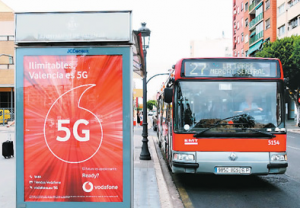
The picture shows an advertisement for the Vodafone 5G commercial mobile network of a multinational telecommunications operator photographed at a bus stop in the eastern Spanish city of Valencia. Vodafone, a multinational telecommunications operator, recently opened its first 5G commercial mobile network in Spain, and Huawei is a core supplier.
Many countries throw “Olive Branches” to China
On June 15, Vodafone, a multinational telecommunications operator, officially launched the country’s first 5G commercial mobile network in Spain. This is only 10 days since the operator launched 5G network services in 5 cities including Rome and Milan. Huawei is one of its major equipment suppliers.
In the past month, many European countries have accelerated the pace of “arrangement” 5G, and Huawei has become a partner of major telecom operators.
On May 30th, BT operator EE opened 5G services in six cities including London. It is reported that EE company uses Huawei equipment in the infrastructure of some 5G networks. In early May, Swiss telecom operators also joined hands with Huawei to officially launch the first batch of 5G smart terminals, becoming the first country in Europe to open 5G commercial services.
According to statistics, in the past three years, Huawei has signed at least 5G cooperation agreements with telecom operators in more than ten EU countries including Germany, Spain, Britain, Austria, Italy, France, Malta, Latvia and Portugal. In the face of a recent wave of “big sticks” against Huawei in the United States, many European countries have chosen to withstand the pressure of the US “Langbang” and continue the original pace of cooperation.
Bloomberg said that in the Sino-US scientific and technological war initiated by the United States, the United States is actually in a state of isolation and helplessness. European countries have clearly stated that they will have their own judgments on Huawei’s participation in China’s 5G construction and trade with China.
It is not only European countries that refuse to “suggest” the United States. The British “Financial Times” reported on May 31 that Huawei and the AU reached a new cooperation agreement to extend the existing cooperation agreement between the two parties for three years. Reuters said that Bahrain plans to launch a commercial 5G mobile network this year, which will use Huawei technology. In addition, several Persian Gulf countries are also conducting technical cooperation with Huawei.
“As of June 6, Huawei has obtained 46 5G commercial contracts in 30 countries around the world, including some of the allies and some European countries that the US has been persuading for some time.” According to the current trend, on the list of Huawei’s partners, new members will soon join.
In fact, it is not only a welcome attitude to Huawei. For other high-tech enterprises in China, countries also choose to throw out “Olive Branches” instead of emulating the United States to raise “big sticks.”
The Helsinki Daily reported in Finland that the Finnish Defence Force will purchase about 150 commercial small drones produced by China’s Dajiang for local troops. Not long ago, the US Department of Homeland Security issued a warning that Chinese drones might send relevant information to China. In this regard, the head of the Finnish Defence Force stated that “their use does not pose a security risk”.
Allies refused to be tied to the “chariot”
“European countries choose to continue to cooperate with Chinese high-tech enterprises such as Huawei and Dajiang based on commercial principles, because these companies have world-leading technologies in related fields, and the prices of products are reasonable and the quality is excellent. European countries procuring their products is a normal one. The business choice.” Zhao Ke, an associate professor of the International Strategy Institute of the Central Party School of the Communist Party of China, said in an interview with this reporter.
Taking Huawei as an example, its leading position in 5G technology is obvious to all, and it has established a good trust relationship with multinational operators. In 2019, which was recognized as the first year of 5G commercial use, countries around the world, including Europe, are gearing up to speed up the construction of 5G. Huawei, which is cost-effective and reliable, is undoubtedly a good partner.
Analysis generally believes that the abandonment of Chinese company equipment may lead to the need for European countries to complete 5G deployments in longer and higher costs. Spain’s “National News” calculated an account: if you replace Huawei equipment with equipment from other companies, the cost of telecom operators will increase by 15%.
The ideas of countries in other regions are mostly similar to those in Europe: they cannot easily give up development opportunities that are in front of them. The US Global Development Center visiting scholar Jiu De Moore wrote an article that the Trump administration’s move to restrict Huawei’s access to US parts has brought the wave of trade war to the African continent. In his view, Africa’s strategic interests run counter to the US’s position on Huawei. Africa should consider its own reality and not have to follow the United States on Huawei issues.
Nowadays, with the passage of time, the real purpose of the United States to pressure countries to join hands to crack down on Chinese technology companies is becoming clearer, which makes countries more aware of the selfishness of the United States, even if the allies are not willing to be tied to the US “chariot.”
The British “Guardian” article bluntly said that the reason why the United States wants to smash Huawei is because Huawei is allowed to develop and may eventually affect the industry status of some US technology giants. Spain’s “National News” believes that the real target of the United States against China is a technical competition. The new “technical iron curtain” will divide the world into two mutually exclusive technical systems, forcing Europe, Africa and other parts of the world to select a side station in the system.
“The United States has repeatedly accused Huawei of having a ‘back door’ and having a ‘security risk’, but has yet to produce conclusive evidence. On the contrary, Huawei has said generously that countries and partners are welcome to test Huawei’s 5G equipment. Finding problems. More and more countries are seeing that the United States is actually in a political purpose, using abnormal means of competition to suppress other countries’ enterprises. This behavior violates the basic spirit of global industrial chain cooperation and win-win, and the United States may use the same in the future. The means to suppress the better-developed enterprises in other countries is difficult for countries to tolerate.” Yuan Zheng, director of the Institute of Foreign Studies of the American Institute of Social Sciences, told this reporter.
“U.S. priority” becomes “American isolation”
Behind the inconsistent pace of Europe and the United States is the divergence between the two sides of the Atlantic.
“Although some European countries and the United States believe that China’s rapid economic development and the improvement of China’s high-tech enterprises’ international competitiveness have brought challenges, there are differences between Europe and the United States in terms of how to treat and resolve challenges.” Zhao Ke pointed out that in typical under the Cold War mentality, the United States raised Sino-US trade disputes to institutional disputes, ideological struggles, and even civilized disputes, using political means to resolve them, even using state machines. European countries adopt the vision of commercial competition and advocate the settlement of trade disputes in the form of normal economic and trade negotiations based on market principles and equal competition with China in a multilateral and open free trade system. “At present, Europe cannot fully accept that the United States will develop economic disputes with China in the field of institutional and ideological confrontation, so it will not follow the United States to adopt the same treatment.” Zhao Ke said.
At the same time, countries are well aware that the development of high-tech industries must be integrated into the global innovation chain and maintain cooperation and exchanges with China and the United States. The United States is trying to weave the technology “blocking the net”, and it will only be harmful and not profitable.
“Global technology development, you have me, I have you. The United States is strongly involved, suppressing Huawei, not only undermines the global science and technology cooperation chain and the global production supply chain, but also impacts on global technology and economic development, and also makes American companies, especially chips. The interests of manufacturers are damaged.” Yuan Zheng said.
Reuters quoted people familiar with the matter as saying that Qualcomm, Intel and other US chip suppliers that have a cooperative relationship with Huawei are persuading the US government to relax its sales ban on Huawei. Broadcom predicts that the US-China trade relationship and the ban will reduce Broadcom’s sales by $2 billion this year, which has shocked global chipmakers.
The US “New York Times” columnist Thomas Friedman wrote that the United States has built a barrier similar to the Berlin Wall in the global technology market, trying to trust those 5G mobile phones, computers and Internet systems that support Chinese technology to support them. The state is isolated from countries that do not trust Chinese technology.
However, in the era of globalization, the world that has already been deeply blended can be so violently isolated.
“As the global hegemon, the United States is constantly pushing for pressure on customs, sanctions, etc., forcing other countries to make concessions and trying to separate the world. This is an interdependence, cooperation and win-win spirit formed by the era of globalization. A complete divergence also makes other countries worry about whether they will be the next target. In the long run, the differences between the United States and its allies will continue to expand, and the ultimate result of this extreme selfishness under the ‘American priority’ policy will be that the United States is isolated.” Yuan Zheng said.
