


Recently, LightCounting released an updated report on the wireless infrastructure market in Japan. The report focuses on Japan’s wireless infrastructure market, and analyzes the impact of Lotte Mobile and the Japanese government’s introduction and promotion of open RAN.
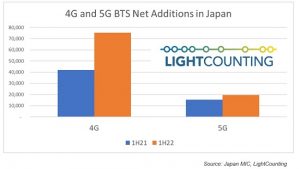
Japan is the first country in the world to deploy open RAN technology. Led by Lotte Mobile and NTT DoCoMo, the former established an open vRAN network from scratch, while the latter introduced open RAN into its brown field network by forcing existing suppliers to open their interfaces. Japan has the most advanced cloud technology: the open RAN base station accounts for 42% of the total devices deployed in 1H22, mainly driven by 4G.
In contrast, 5G fell sharply in the second quarter of 2012, as natural disasters exacerbated the existing supply chain problems.
Stephane Teral, chief analyst of LightCounting market research company, said: “Despite unexpected fluctuations in its domestic market, NTT DOCOMO’s OREC plan and Lotte Symphony have both adhered to their international expansion routes, as have Fujitsu and NEC. Both suppliers continue to build their international influence through their open RAN product portfolio and system integration services.”
LightCounting believes that the Japanese RAN market is full of vitality and shows an upward trend, from a strong 4G deployment in 2021 to a major 5G deployment this year and next. LightCounting’s model is based on the 5G road map of the MIC of Japan, which points out that this year and next year will increase significantly, and then decrease significantly from 2024. According to the long-term plan of MIC, the RAN market is expected to rebound in 2026. By 2027, the open RAN base stations will account for more than 60% of the headquarters.
Main findings of the report:
- After a strong performance in 2021, 4G deployment will surge again in the first half of 2022. LightCounting believes that 4G deployment will slow down in the second half of 2022.
- Lotte Effect has brought many suppliers to the Japanese ecosystem, which helps NTT DOCOMO promote its OREC plan.
- In general, Japan’s approach to disaggregation is tactical, pragmatic and radical.
- Despite the poor performance in the second quarter of 2022, the analysis still believes that 2022 will be a year of 5G growth.
- Driven by the Ministry of Internal Affairs and Communications of Japan, LightCounting’s recent RAN forecast shows that RAN will fluctuate before the beginning of the next cycle before the end of the five-year forecast period, and then decline.
