


Professor Hu Wei and Prof. Lu Yanqing from Nanjing University cooperated with Prof. Li Quan from Kent State University in the United States to realize continuous adjustable and conjugate phase-distributed light in the working band by designing a self-assembled spiral superstructure incorporating a light-controlled chiral flipping molecular machine. A controlled planar photonic element provides a practical solution for a dynamic planar photonic element. The results were published on Nature Communications on June 7, 2019 under the title “Chirality invertible superstructure mediated active planar optics”.
“2019 China’s Top Ten Optics Progress” Candidate Recommendation
Wavefront regulation is at the core of optical applications. As modern photonics technologies continue to evolve toward miniaturization, integration, versatility, and dynamic tuning, traditional dynamic phase optical components are no longer adequate due to their large size and relatively single function. In recent years, the rapidly developing geometric phase provides an integrated planar optical component implementation. However, most of the geometric phase components are static and once installed, their function is fixed. The development of dynamically tunable geometric phase components unlocks the operating wavelength and functional limitations of planar optics, enabling the creation of new adaptive, versatile photonic component designs. Researchers have developed strategies such as stretching substrates, material phase transitions, and controlled chemical reactions to achieve these goals, but simple, efficient, and practical dynamic planar photonic components remain a challenge.
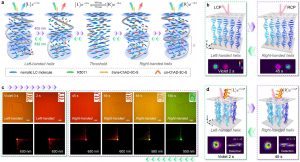
Figure 1. a, schematic diagram of the bidirectional evolution of the CLC spiral superstructure driven by violet and green light; b, light-controlled beam deflector; c, ultra-wideband Airy light converter; d, vortex OAM light-controlled reversal
In response to this problem, the team collaborated with Prof. Li Quan from Kent State University in the United States based on the research of the pre-digital spiral superstructure preparation broadband parallel vortex optical processor (Adv. Mater. 2018, 30, 1705865). Excavating the external field excitation response characteristics of the cholesteric liquid crystal (CLC) helium, mixing the photo-molecular machine and chiral agent with opposite chirality, and obtaining a self-assembled spiral superstructure capable of photo-controlled flipping. Further, the liquid crystal light alignment technology is used to induce patterning assembly, and a series of planar photonic elements such as a beam deflector, a microlens, and an Airy/Vortex generator are obtained. Excited by a specific wavelength of light, the above components can be bidirectionally tuned in the wavelength range from green to communication over 1000 nm. At the same time, the chiral flip is accompanied by a conjugate reversal of the geometric phase, resulting in a light-controlled reversible transformation of component functions such as beam deflection direction, focus/divergent state, and vortex rotation.
In this work, the extensive range of working band tuning and geometric phase dependent functional transformations relies only on changes in the CLC spiral superstructure caused by uniform light stimulation. Thanks to the synergistic effect of “bottom-up” CLC spiral self-assembly and “top-down” light-controlled patterning orientation, the solution exhibits higher design flexibility, while being easy to prepare, low cost, etc. Advantage. Compared with mechanical, temperature, electric field and other control methods, light control has a higher spatial and temporal resolution as a non-intrusive remote control method. This research provides a new practical solution for the design and preparation of dynamic planar photonic elements.
The first author of the thesis is Dr. Chen Peng from Nanjing University (2018 Wang Dazhao Optics Award winner of the University Student Optical Award). Professor Hu Wei, Professor Lu Yanqing and Professor Li Quan are the co-authors of this article. Nanjing University is the first unit and communication unit. Dr. Ma Lingling, Shen Zhixiong, Wu Saib, Ge Shijun, and Dr. H. Bisoyi from Kent State University also made important contributions to this article.
The research was funded by the National Key Research and Development Program, the Natural Science Foundation, the Jiangsu Outstanding Young Scholars Fund, and the “Zhong Yingyoung Scholars” Fund. At the same time, I would like to thank the Artificial Microstructure Science and Technology Collaborative Innovation Center and the Nanjing University’s 1,000 projects. The central university’s basic scientific research business fees and other platforms and projects support.
