


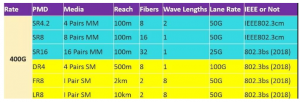
According to the different distance requirements of the data center 400G, a series of Ethernet standards have been released. These standards seem to be complicated and there are some common rules: SR stands for transmission distance of 70, 100 or 150 meters, using multimode fiber; DR stands for The transmission distance is 500 meters, using single mode fiber; FR stands for transmission distance of 2000 meters, using single mode fiber; LR stands for transmission distance of 10km, using single mode fiber; ER stands for transmission distance of 40km, using single mode fiber. The numbers following the SR and DR represent the fiber logarithm. The IEEE 802.3bs standard was released in 2018, and the IEEE 802.3cm standard is under development. It is expected to be formally approved by the end of 2019. In addition to the IEEE’s completed and ongoing standards, if you add MSA’s 400G application, there are no fewer than 10 400G applications that you can refer to. For users in the data center, it feels like a lot of applications. According to Rosenberg’s analysis, it is only necessary to focus on four of them.
400GBase-SR8
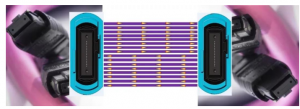
Multi-mode fiber single-wavelength unidirectional 8 channels are used, and 50G is transmitted per channel. The interface uses a 16-core dedicated MPO or a 24-core two-row MPO interface. Multimode fiber can be used with OM3, OM4 and OM5, and the lengths supported are 70 meters, 100 meters and 150 meters respectively. The characteristics of this application are: 16-core fiber for each interface supports a large amount of fiber, and single-wavelength applications make the transceiver cost low.
400GBase-SR4.2
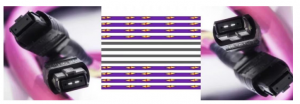
Using four parallel transmission technologies and wavelength division multiplexing technology, each channel transmits two-way 50G total 100G. The interface can be an ordinary 12-core MPO, 8 cores on both sides can be used for transmission, and multimode fiber can use OM3, OM4 and OM5, and the supported lengths are 70 meters, 100 meters and 150 meters respectively. This application features: the interface is backward compatible with 40G/100G, but due to the use of wavelength division multiplexing, the cost of the transceiver is higher than that of a single-wavelength transceiver.
400GBase-DR4
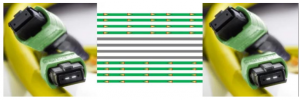
Single-mode fiber single-wavelength parallel transmission technology is adopted, and each channel transmits one-way 100Gbps. The interface can be a common 12-core single-mode MPO, and 8 cores on both sides can be used for signal transmission, supporting an application distance of 500 meters. Application features: The interface is backward compatible with 40G/100G. With single-wavelength applications, the cost of the transceiver is relatively cost-effective, and the cost is higher than that of the multi-mode transceiver.
400GBase-FR8
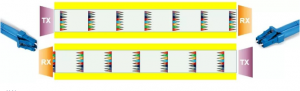
Single-mode fiber 8-wavelength wavelength division multiplexing technology is used to transmit 50 Gbps per wavelength. The interface can be a common single-mode LC, supporting an application distance of 2 kilometers. This application features: long support distance, only a pair of single-mode fiber, the interface can use ordinary single-mode LC, due to the use of CWDM applications, the transceiver cost is very high.
Summary
Although there are no less than 10 application modes for 400G, from the perspective of data center applications, the model of the mainstream 400G application in the future will not exceed the above four types. From the perspective of the evolution of data center backbones, the support application distance of multimode fiber can basically meet the needs of 90% of data center backbone applications. From the current situation of domestic and foreign Internet giants including Google, Tencent and other companies, 400GBase-SR8 is a relatively optimistic application model.
