


AMD will leverage the power of GlobalFoundries to develop a CPM based CPO solution for its next-generation Instinct MI500 AI accelerator.
GlobalFoundries collaborates with AMD to develop co packaged optical hardware for the Instinct MI500 accelerator
CPO, also known as co encapsulated optics (silicon photonics technology), is the next generation solution that reduces reliance on copper and utilizes light to transmit signals. These CPOs, packaged together with hardware accelerators such as GPUs, will become a key solution for the next generation of AI factories, providing improved interconnect latency and establishing high bandwidth connections between CPUs and GPUs.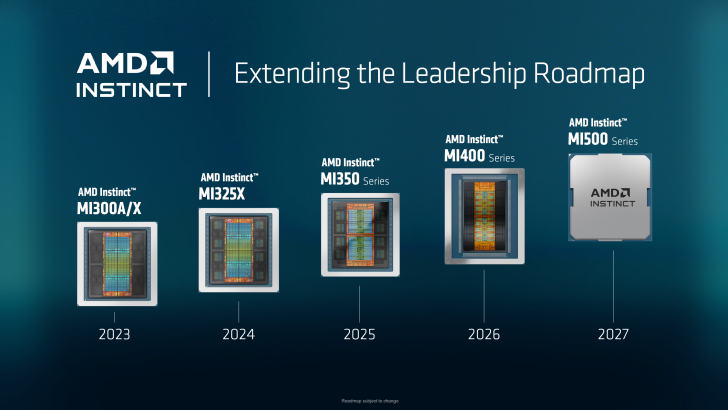
AMD and Nvidia will both adopt these technologies for their next-generation AI GPU accelerators. According to the latest information, AMD will develop a CPM based CPO solution for its next-generation Instinct MI500 accelerator. PIC (Photon Integrated Circuit) will be manufactured by GlobalFoundries, while ASE will be responsible for packaging work. Last year, AMD acquired photonics expert Enosami to accelerate its innovation in co packaged optics.
Similarly, Nvidia is reportedly developing its own CPO photonic integrated circuit for its Vera Rubin accelerator, with PIC manufactured by TSMC and packaging handled by SPIL. The chip itself will be assembled in Foxconn Industrial Internet or Industrial Fulian (a subsidiary of Foxconn). For Rubin Ultra, CPO scheme will take priority over NPO (Near Package Optics).
Looking ahead, Nvidia will fully adopt co packaged optics and completely eliminate the need for NPOs in its Feynman generation AI accelerator.
As for AMD, the company has confirmed that its MI500 series will be manufactured using advanced 2-nanometer process technology. The upcoming MI400 series also uses 2-nanometer process technology, but the MI500 adopts a more advanced process and provides multiple enhanced features. The chip will be produced by TSMC.
The MI500 accelerator will adopt a brand new CDNA 6 architecture (CDNA 5 for the MI400 series), as well as HBM4E memory, which will have higher speed and memory bandwidth than the 19.6TB/s achieved by HBM4 on the MI400 accelerator. Furthermore, contrary to previous reports, AMD does not seem to change the architecture naming of Instinct GPU to UDNA.
AMD promises significant improvements in AI performance for the Instinct MI500 series. The company is expected to achieve over 1000 times AI performance growth within four years. This is crucial for meeting the growing demand for AI and keeping up with the accelerating competition. MI500 will be released in 2027.
