


Based on the allocation of BEAD funds in various states in the United States and the network coverage of each operator in these states, analysts believe that AT&T and Charter Communications are most likely to benefit the most from the billions of dollars in Broadband Equity Access and Deployment (BEAD) program.
ISI Evercore analysts speculate in a research report that the larger the market share of an operator in a state, the more likely they are to benefit from expansion near their existing footprint. ISI Evercore points out that after further segmentation, AT&T and Charter have 33% and 27% of residential broadband users, respectively, from the two states with the highest number of broadband users in the United States – Texas and California.
They added that Comcast will also have the opportunity to “gain a subsidy advantage” and may seek active bidding in parts of Texas, Michigan, Washington, Florida, and Illinois where it has established itself.
AT&T, Charter, and Comcast have all expressed interest in participating in the project in some form.
A few days before the release of the ISI Evercore evaluation report, the White House announced that it would allocate over $40 billion in broadband funds through the $42.5 billion BEAD project. Texas is far ahead with $3.3 billion, followed by California ($1.8 billion), Missouri ($1.7 billion), Michigan ($1.56 billion), and North Carolina ($1.53 billion). The top five states account for 24% of total funding, while the top ten states account for 40%.
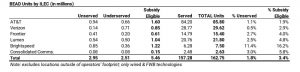
New Street Research also conducted an analysis of BEAD funding in each state. In terms of cable TV operators, New Street has found that Charter has the greatest opportunity, followed by Comcast, Cox Communications, and Altice USA. In terms of telecom operators, New Street believes that AT&T has the greatest advantage, followed by Verizon, Frontier Communications, and Lumen.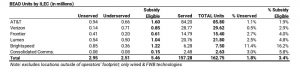
According to the current schedule, New Street expects operators to start bidding for BEAD funds from the first quarter of 2024 to the mid to late 2024. Analysts added that the funds should be disbursed in 2024, with expenditures “truly in place starting from 2025”.
