


A new report by Ookla shows that the growth rate of global fixed broadband speed exceeds the mobile speed. However, overall, as countries continue to invest in optical fiber and 5G, the network speed around the world is increasing.
In terms of fixed services, the download speed of broadband services has increased by 28% in the past year. In contrast, according to the Speedtest Global Index, the mobile speed increased by nearly 17% from November 2021 to November 2022.
In terms of upload speed, Ookla’s data shows that the fixed growth is also faster. In the past year, mobile upload speed has increased by at least 9%, while fixed broadband upload speed has increased by at least 30%.
In terms of latency, both fixed and mobile changes are small. Ookla pointed out that delay is becoming an increasingly important indicator. In the past year, the mobile delay dropped from 29 milliseconds in 2021 to 28 milliseconds in 2022, while the fixed broadband delay remained at 10 milliseconds.
Mark Giles, an industry analyst at Ookla, said that “many factors” played a role in the overall improvement of the global download speed and the current performance in the fixed broadband field.
Giles said in an email to Light Reading: “In terms of mobile download speed, 5G has established itself in many mature markets. Therefore, most of the improvements brought by 5G technology have been highlighted in the figures in 2021. In addition, with the expansion of 5G coverage, the median performance is likely to decline. This is because more users will flock to new networks, and the availability of networks in urban areas with low density using low-frequency spectrum will be improved.”
In terms of fixed business, Giles said that at present, the increase in optical fiber investment and other aspects of progress are playing a role. He said: “From the perspective of the overall fixed broadband performance, the penetration rate of optical fiber continues to increase, and many regulators give priority to accelerating deployment, coupled with the adoption of more advanced WiFi (such as WiFi 6 and 6E), these are the factors that significantly improve the download speed of global fixed broadband.”
Ten fastest growing countries
Although most of the top 10 countries with the fastest fixed network speeds in 2021 will be on the list in 2022, there will also be some significant changes. For example, in the past year, Chile’s download speed jumped from 173.08 Mbit/s to 216.46 Mbit/s. This growth makes Chile the first, almost equal to China (214.58 Mbit/s) and Singapore (214.23 Mbit/s). The download speed in China and Singapore has also increased compared with last year.
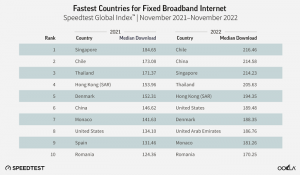 The United States jumped from the eighth place in 2021 to the sixth place in 2022. The average download speed in 2022 was 189.48 Mbit/s.
The UK does not enter the top ten of fixed broadband every year. Spain ranked ninth in 2021, but fell out of the top ten in 2022, making room for the United Arab Emirates (UAE), which joined the ranking with a median download speed of 186.76 Mbit/s.
In the mobile field, Qatar jumped to the top with a median download speed of 176.18 Mbit/s (98.1 Mbit/s in November 2021). This was followed by the United Arab Emirates at 139.41 Mbit/s.
Denmark (113.44 Mbit/s), Macao (106.38 Mbit/s) and Brunei (102.36 Mbit/s) replaced Saudi Arabia, Cyprus and Kuwait in 2022. Neither the United States nor the United Kingdom is in the top 10 mobile speed list.
