


At 23:23 on May 8, a spokesperson for the Ministry of Commerce made a statement on the US proposal to upgrade tariffs.
A spokesperson for the Ministry of Commerce said that the US intends to raise the tariff of 200 billion US dollars of Chinese exports to the United States from 10% to 25% on May 10. The escalation of trade friction is not in the interests of the people of the two countries and the people of the world. The Chinese side deeply regrets that if the US tariff measures are implemented, China will have to take necessary countermeasures.
According to the arrangement, Liu He, member of the Political Bureau of the CPC Central Committee, vice premier of the State Council, and Chinese leader of the China-US Comprehensive Economic Dialogue, will visit the United States from May 9 to 10 to conduct the eleventh round of consultations with the US on economic and trade issues.
The Ministry of Commerce said late at night: China will have to take necessary countermeasures
On the eve of Prime Minister Liu He’s visit to the United States, the Ministry of Commerce made a speech at midnight and made a speech on the US proposal to upgrade tariffs.
A spokesperson for the Ministry of Commerce said that the US intends to raise the tariff of 200 billion US dollars of Chinese exports to the United States from 10% to 25% on May 10. The escalation of trade friction is not in the interests of the people of the two countries and the people of the world. The Chinese side deeply regrets that if the US tariff measures are implemented, China will have to take necessary countermeasures.
In the past week, the world has been paying close attention to the progress of China-US trade consultations.
The Ministry of Commerce confirmed that at the invitation of US Trade Representative Wright Heze and Finance Minister Muchin, members of the Political Bureau of the CPC Central Committee, Vice Premier of the State Council, and Chinese leader of the China-US Comprehensive Economic Dialogue will visit May 9-10. The United States and the United States conducted the eleventh round of consultations on economic and trade issues.
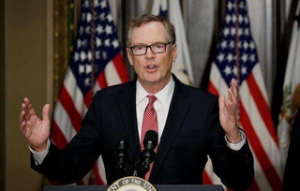
Wright Heze
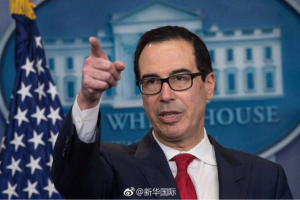
Muchin
At the press conference of the Ministry of Foreign Affairs held on the 8th, the spokesperson Geng Shuang said that China always believes that mutual respect, equality and mutual benefit are the premise and basis for reaching an agreement, and the addition of tariffs will not solve any problems. Negotiation itself is a process of discussion. It is normal for the two sides to have differences. China does not evade contradictions and is sincere in continuing consultations.
Geng Shuang said that China’s position and attitude have always been very clear, and the US side is also very clear about this. The Sino-US economic and trade consultations have been carried out for ten rounds and have made positive progress. As a matter of urgency, China still hopes that the US and China will work together and work toward each other, striving to reach a mutually beneficial and win-win agreement on the basis of mutual respect. This is not only in line with the interests of the Chinese side, but also in the interests of the US, and it is also the general expectation of the international community.
People’s Daily: Tariffs are not a panacea
The People’s Daily published a comment entitled “The Key Points are Seen”. The author of the article “Zhong Sheng” pointed out that China’s position and attitude have always been very clear, and the US is very clear about this. So far, ten rounds of high-level Sino-US economic and trade consultations have made a lot of progress, which is obvious to all. The consultations have reached a critical point. Only by working together and facing each other can the two sides strive to reach a mutually beneficial and win-win agreement on the basis of mutual respect.
There are indeed difficult structural differences between China and the United States that are difficult to resolve at the moment. It is necessary to find ways through dialogue and exchange. The original intention of the negotiations is to solve the problem. The goal is to promote a win-win situation. Therefore, it is inseparable from the serious treatment of each other’s concerns, and the inclusiveness of each other’s adaptability and operability. By spelling the door and arranging words, it is impossible to solve the Sino-US economic and trade issues. The tariff bar is not a panacea.
The commentary mentioned that China’s big market is full of vitality, China’s economic power is constantly increasing, and the space for China’s interaction with global economic and trade partners continues to expand. China is fully emboldened to cope with the various difficulties and challenges in the Sino-US economic and trade consultation process. This is also the reason why China can always maintain its normal heart. The key points are calm. After talking about it, it is in the interest of both China and the United States and it is also in the interest of the world. It is worth emphasizing that China and the United States have clearly agreed to expand cooperation on the basis of mutual benefit, manage differences on the basis of mutual respect, and jointly promote Sino-US relations based on coordination, cooperation and stability. The United States should firmly follow the direction of this consensus guide and push bilateral economic and trade relations back to normal track as soon as possible, so that cooperation and mutual benefit can benefit both countries and the world. This is the great power of the big country that believes in keeping promises.
The Global Times also published relevant comments. The commentary mentioned that China and the United States are talking about it. Even if the negotiations break down, the United States will impose a comprehensive tariff, which does not mean that the door to negotiations will be closed. The extreme pressure on the US side shows that the US is in a hurry to reach an agreement early. The more it is at this time, the more China must maintain its strength. The “fever” of the Sino-US trade war is once again high, and burning for a while is not necessarily a bad thing for China in terms of strategy. At the same time that we suffer losses, the US will also accumulate a lesson in the process of increasing losses. If a trade agreement can be reached, it will be more stable.
Ten rounds of economic and trade consultations have been held
From April 30 to May 1, Chinese Vice Premier of the State Council, Chinese Leader of the China-US Comprehensive Economic Dialogue, Liu He, and US Trade Representative Wright Heze and Finance Minister Mnuchin held the 10th round of China-US high-level economic and trade consultations in Beijing. The two sides will hold the 11th round of China-US high-level economic and trade consultations in Washington this week in accordance with the established arrangements.
Mnuchin said on April 30 that he hopes to have “substantial progress” with the Chinese negotiators in the next two rounds of trade negotiations.
In the past ten rounds of economic and trade consultations, from the news disclosed by the Ministry of Foreign Affairs and the Ministry of Commerce, the two sides negotiated on the text of the agreement, in technology transfer, intellectual property protection, non-tariff barriers, services, agriculture, exchange rates, financial services, Substantial progress has been made on specific issues such as trade balance.
Since the beginning of this year, the Sino-US economic and trade team has conducted intensive consultations, basically all around the relevant texts of the agreement. So far, ten rounds of consultations have been held.
From January 7th to 9th, China and the United States held consultations at the vice-ministerial level on economic and trade issues in Beijing. The two sides actively implemented the important consensus of the two heads of state and conducted extensive, in-depth and meticulous exchanges on trade issues and structural issues of common concern, which enhanced mutual understanding and laid the foundation for resolving mutual concerns. Both parties agreed to continue to maintain close contact.
From January 30th to 31st, Liu He led the Chinese team to hold economic and trade consultations with the US team led by Wright Heze. Under the guidance of the important consensus reached by the two heads of state in Argentina, the two sides discussed trade balance, technology transfer, intellectual property protection, non-tariff barriers, services, agriculture, implementation mechanisms and Chinese concerns. The leaders of the two sides focused on frank, concrete and constructive discussions on issues of trade balance, technology transfer, intellectual property protection, implementation mechanisms, and issues of concern to China, and made important progress.
From February 14 to 15, Liu He and Wright Heze and Finance Minister Mnuchin held a sixth round of high-level Sino-US economic and trade consultations in Beijing. The two sides conscientiously implemented the consensus of the two heads of state in Argentina, on technology transfer, intellectual property protection, Non-tariff barriers, service industries, agriculture, trade balance, implementation mechanisms and other issues of common concern and China’s concerns have been thoroughly exchanged. The two sides reached a principled consensus on the main issues and conducted specific consultations on the bilateral economic and trade memorandum of understanding. The two sides stated that they will work hard to reach an agreement based on the consultation period determined by the two heads of state.
The seventh round of China-US high-level economic and trade consultations started on February 21. China has repeatedly expressed its position that Sino-US economic and trade cooperation is mutually beneficial and win-win. Sino-US economic and trade relations are not only important to China and the United States, but also important to the development of the global economy and trade. China and the United States and the two interests, fighting is hurt. Both sides have a positive desire to implement the important consensus reached by the leaders of the two countries and promote relevant consultations.
From March 28th to 29th, Liu He, member of the Political Bureau of the CPC Central Committee, vice premier of the State Council, and Chinese leader of the China-US Comprehensive Economic Dialogue, and US Trade Representative Wright Heze and Finance Minister Mnuchin co-chaired the eighth round of China and the United States in Beijing. High-level economic and trade consultations.
From April 3 to 5, Liu He, member of the Political Bureau of the CPC Central Committee, vice premier of the State Council, and Chinese leader of the China-US Comprehensive Economic Dialogue, and US Trade Representative Wright Heze and Finance Minister Mnuchin co-chaired the ninth round of China and the United States in Washington. High-level economic and trade consultations. The two sides discussed the texts of agreements on technology transfer, intellectual property protection, non-tariff measures, services, agriculture, trade balance, and implementation mechanisms, and made new progress. The two sides decided to further negotiate on the remaining issues through various effective methods.
From April 30th to May 1st, Liu He, member of the Political Bureau of the CPC Central Committee, vice premier of the State Council, and Chinese leader of the China-US Comprehensive Economic Dialogue, and US Trade Representative Wright Heze and Finance Minister Mnuchin held the 10th round in Beijing. High-level consultations on US economic and trade relations.
In 2018, the trade in goods between China and the United States exceeded $630 billion, and the two-way investment totaled more than $240 billion.
The transcripts of the Chinese economy in the first quarter of this year showed that GDP grew by 6.4% year-on-year, higher than domestic and international analysis, industrial, consumption, investment, import and export growth accelerated, and new jobs in urban areas were 3.24 million; The data of the General Administration of Customs showed the highlight of import and export. In March, the total value of foreign trade imports and exports exceeded the expected growth of 9.6%, which effectively boosted the overall growth rate of foreign trade in the first quarter. Although China-US trade friction has brought about a negative impact, China has launched a series of policy measures around “stable employment, stable finance, stable foreign trade, stable foreign investment, stable investment, stable expectations” and achieved remarkable results.
