


As a “long-distance runner”, Huawei has been constantly interpreting the drama from catching up to surpassing and even entering the “no-man’s land” in various fields of the ICT industry.
“The Pacific Broad Pipeline (Network)” is the base of the digital world. The carrier-grade (carrier-grade) router as the “sluice gate” directly affects the size of the pipeline. The importance is self-evident, Huawei and Cisco. The first battle has become a major theme in this market in recent years.
Just recently, an annual market report released by IHS Markit has once again set off waves. In 2018, Huawei routers achieved an annual revenue growth of 8.6% in the carrier market, ranking first in the market with 30% market share. This is the first time that Huawei’s IP core routers have surpassed the annual market share of the overall operator IP routers in 2017 after ranking first in the global carrier market share.
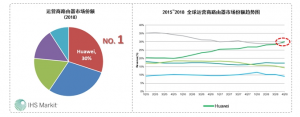
“The past three years (changes in the market landscape) are the story of the rise of a Chinese supplier. China’s telecommunications infrastructure investment is very high, and Huawei has also achieved success outside of China, in other parts of Asia, Europe/Middle East and African region (EMEA) and China-US Latin America (CALA) are also very influential.” The report pointed out that “especially in the fourth quarter of 2018, Huawei’s performance in IP core routers was very strong, achieving a market share of 47%. Set a new record.”
23 years of thorns: from technology beyond to market transcendence
In the data communications (router, switch) market, Cisco used to be the presence of the mountain, the world’s first routing product (AGS) comes from it, and always maintains considerable technical leadership. It took 23 years for Huawei to turn over this mountain. The reference to the performance of the line card is 17 years. It is called the blue road and the thorns.
“Developing Chinese own data communication products”, this is the initial heart of Huawei’s journey to the router. In 1995, the Shenzhen-based company set up a research institute in Beijing, which opened the prelude to independent research and development of routers. At that time, the team had less than 10 people. Two years later, the first router model Quidway R2501 was introduced.
In 2000, Huawei, with its ability to serialize its routing products, began to emerge in the data communications market with the launch of China’s first high-end router, NetEngine. In 2004, the flagship core router NetEngine 5000 was released, which was applied at the core of China Telecom Guangdong Metropolitan Area Network. In 2006, it launched the NetBack 5000E, an innovative back-to-back cluster system. This technical breakthrough eliminates the need for a central switching frame, saves a significant total cost of ownership (TCO), and smoothly upgrades to network development. Supporting more box clusters, only the Chinese and American suppliers mastered at that time, thus creating a new pattern of “three points in the world”.
In September 2012, Huawei released the 480G routing line card for the industry for half a year, igniting a new round of throughput competition and leading the IP backbone network into the 400G era. It was also since then that Huawei has achieved technical overtaking. In April 2013, when the industry was still immersed in the attention of the 480G, the company released its 1T line card at its annual analyst conference, this time it has led other suppliers for 1-2 years.
Since then, Huawei has taken the lead in router technology innovation and has achieved industry and business processes in key technical areas such as SRv6, FlexE, single-port 400GE, and cloudized BNG.
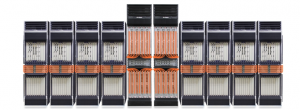
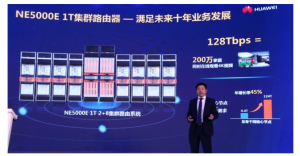
In 2016, it released the industry’s first 1T platform 2+8 cluster core router to create the most evolved backbone network platform with a maximum (cluster) capacity of 128T. In 2017, the company launched the industry’s first 50G FlexE-based 5G bearer fragmentation router, providing 50GE base station access capability, seamlessly compatible with 100GE, and implementing port-based physical isolation based on innovative FlexE technology to provide differentiated SLAs for different services. Guarantee. In the same year, the industry’s first single-port 400GE was introduced and the first commercial deployment. In 2019, China Telecom deployed the world’s first SRv6 commercial office in Sichuan.
Today, Huawei’s carrier-class routing products are deployed in more than 130 countries and regions around the world, serving more than 1.7 billion users worldwide. In terms of industry influence, it is a member of the board of directors in standards organizations such as IEEE, CCSA, ATIS, BBF, ETSI and OMA, and has served as the chairman of 9 IETF working groups. In 2018, the IETF IP field active draft number ranks the first in the world.
Beyond Behind: The Leading Lead from the “Core” under Pressure
How does Huawei achieve this feat in the carrier-class router market? The reason is the continuous innovation under pressure and the control of customer demands.
Take the chip as an example, this is undoubtedly the core of routing products, and Huawei has long recognized the importance of self-study. Since 1999, it has developed a Solar chip based on ASIC architecture, which was officially commercialized in 2004. In the 3.0 era, the Solar chip has been leading the industry and has evolved to version 5.0 based on the NP architecture.
Solar 5.0 was released in 2016, using 16nm process and integrating 4.5 billion gates. It is the world’s first T-class network processing engine (single chip 1.2T), which has 2.2 times the industry’s 288 cores and 1.5 times the industry. 3168 threads; continuous optimization on the architecture has increased throughput by 4 times compared to previous generations. In terms of reliability, Huawei created the Atom-NPU-Thread three-level isolation technology and introduced Memory full verification to eliminate single-bit soft failure. In terms of energy consumption, Solar 5.0 is 37% lower than the previous generation by supporting dynamic frequency modulation (10% savings per frequency reduction) and smart switching core technology (0.2W saving single core). In terms of new technology integration, it supports more than 10 layers of SRv6 high-performance forwarding, us-level Telemetry data acquisition, and FlexE/FlexE+.
“Which is the power of the wild,” especially in technology-intensive areas, success depends to a large extent on the determination to invest in innovation. According to Huawei’s latest annual report, its research and development expenses reached 101.5 billion yuan in 2018, accounting for 14.1% of sales revenue. It ranked fifth in the industry investment and research investment in the 2018 released by the European Union; in the past ten years, it has accumulated in research and development. More than 480 billion yuan was invested. According to recent data released by the United Nations’ World Intellectual Property Organization (WIPO), in 2018, Huawei filed 5,405 patent applications with the agency, ranking first in the world.
In the field of data communications, the company has integrated global R&D resources to create industry-leading products. These include the Algorithm Learning Research Center in Paris, France, the Chip Pre-Research Center in Silicon Valley, the Superconducting Materials Research Center in Yokohama, Japan, the Network Planning Laboratory in Munich, Germany, the VRP Platform R&D Center in Bangalore, India, and Beijing, Nanjing, and Shenzhen.
From the perspective of customer appeal, in addition to the traditional “three measurements” of performance, power consumption, and integration, reliability is an important indicator for operators to measure routing products. Huawei is well aware of this. In order to allow operators to “buy at ease, use peace of mind”, and even made a “zero accident” commitment to router products. To this end, it not only built the industry’s largest automated test factory with more than 3,700 devices, more than 100,000 test cases, 1:1 simulation of live network operation, and developed a100% coverage of single-board solder joints. The industry’s first intelligent hardware test system, which was manually intervened, also developed stringent quality standards covering the entire lifecycle, from design to development, from production to installation.
In addition, the stability requirements of the network also determined that the inventory equipment is difficult to be replaced, and once became a gap in the face of the market latecomers. Huawei has also accumulated rich engineering construction experience and developed corresponding tools in this regard. In September 2012, it assisted China Unicom to smoothly relocate the core cluster routers in Wuxi, which was not damaged. This was the largest and most challenging IP trunk network relocation project at that time, which completely eliminated the operators’ concern.
“Bobview and approx, thick and thin hair”, chasing from the 10G, 40G era, to the 100G era side by side, and then to the 400G, 1T era of beyond and leading, Huawei’s carrier-class router this inspirational trajectory is China A microcosm of the global rise of ICT power, this market share jumped to the top of the list also marked an era of change. In the face of the upcoming 5G era and intelligent era, Huawei said that it will continue to implement the concept of minimalist architecture, minimalist protocol, minimalist site, and extremely simple operation and maintenance, in network architecture, intelligent operation and maintenance, network protocol, forwarding chip, and high-speed. The field of ports and other fields is constantly innovating, leading the intelligent IP network, and is committed to bringing the digital world to everyone, every family, every organization, and building a smart world of Internet of Everything.
