


The National Telecommunications and Information Administration announced on July 31 that the Trump administration has approved research on the 4.4GHz frequency band for commercial use of 6G by wireless operators. NTIA Administrator Arielle Roth stated that NTIA, responsible for federal spectrum management, has responded to the call of Congress and President Trump to urgently promote the reallocation of federal spectrum to ensure that the United States leads the world in the 6G field. Roth stated in a statement, “With today’s announcement about 4.4GHz, our four reserve frequency bands are now advancing synchronously – for the first time in history, indicating that we are operating at the speed and precision required to fulfill our mission. ”
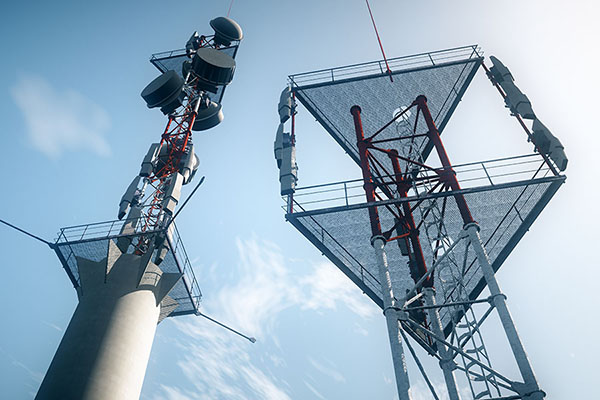
5G Telecommunication Tower under Blue Sky 3D Illustration
The other three frequency bands being studied are 1.6GHz, 2.7GHz, and 7GHz. The 4.4GHz frequency band still needs to go through the review process of the Business and Appropriations Committee before the Office of Management and Budget can allocate the necessary research funds. NTIA is authorized by Congress to identify 500MHz federal spectrum for commercial use within five years. Last December, the President instructed NTIA to complete research on the 7.125-7.4GHz frequency band within 12 months. According to NTIA, these authorizations are at the core of ensuring the United States leads in the 6G field.
Advantages of 4.4GHz frequency band
Currently, at least 12 federal agencies are using the 4.4GHz frequency band, with the Department of Defense and the Department of Justice being the largest existing users. According to Fierce’s previous report, the 4.4GHz frequency band has multiple attractions for 6G: it has no legacy commercial services, existing DoD users (radar and tactical systems) have clear situations, the propagation characteristics of 4.4GHz are similar to those of the C-band, and it provides a continuous bandwidth of 500MHz.
At the 6G forum earlier this week, attendees stated that the advantage of the United States is that its spectrum reserves are in place – the Upper C-band auction is tentatively scheduled to start on April 27, 2027, but the spectrum will not be deployed in major markets until December 2030, and in other regions until July 2031. Juniper Research expects the first batch of 6G connections to be launched by the end of 2029.
