


Although 5G standalone networks (5G SA) are not yet the norm in the United States, according to data shared by Ookla this week, they offer higher download speeds and are steadily improving.
Not all countries are like this. Ookla noticed that as more and more customers load onto carrier networks, the download speed of some 5G SAs has decreased. But in the United States, the median download speed continues to rise, partly due to T-Mobile adding extra spectrum earlier this year.
According to Ookla’s data, in the second quarter of 2024, the median download speed for 5G non standalone (5G NSA) in the United States was 170.90 Mbit/s. Without decomposing individual networks, Ookla found that the median download speed of 5G SA in the United States during the same quarter was 364.53 Mbit/s.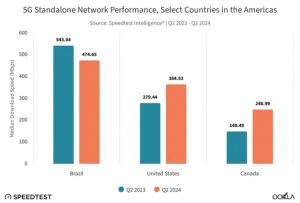
Ookla’s data is based on devices running its Speedtest application; When the application is running tests, Ookla can determine which network the device is connected to while checking the device speed. Our data shows that in the United States, there are 4.3 times more 5G NSA users than 5G SA users, “wrote Ookla industry analyst Karim Yaici in response to Light Reading’s question
The 5G SA competition among nationwide operators in the United States is taking place between T-Mobile and EchoStar’s Boost Mobile (formerly known as Dish Wireless). Boost’s green and open RAN 5G SA network covers 99% of the U.S. population, but still includes roaming coverage of partner networks. UScellular also deployed 5G SA, but it did not cover the entire country and was acquired by T-Mobile.
Although network speed may not be very important to consumers in most cases, it has always been a topic of discussion for the marketing departments of telecom operators. Regarding 5G SA, T-Mobile is conducting all discussions as analysts believe that due to its lower spectrum, it has better 5G coverage, which can cover more locations while providing coverage in buildings and homes.
As reported this week, Opensignal’s recent survey on the proportion of time people spend connected to the internet in their most frequent places shows that in the eyes of customers, T-Mobile is far ahead of AT&T and Verizon in terms of 5G coverage.
Even without a 5G SA network, 5G customers may soon receive better coverage due to partnerships with several operators and investments in satellite to device (D2D) coverage. Satellite coverage will help expand the coverage area of 5G and may enhance consumers’ perception of its coverage.
This coverage will also become a factor for operators to provide new services. The new revenue streams are also the motivation behind most 5G network expenditures, although the functionality of 5G networks is limited without independent 5G cores.
Ookla’s Yaici wrote in a blog post earlier this week: “In addition to speed, 5G SA also promises new features, such as network slicing, which have begun to appear in the most advanced markets, but for most consumers and businesses worldwide, becoming a reality will take time.”
