


At present, the mainstream operators in the world have started the transformation of the basic network for cloud services, such as AT&T’s Domain2.0, Deutsche Telekom’s PAN-EU, China Telecom’s CTNet2025, China Unicom’s CUBE-Net, China Mobile’s NovoNet and so on. However, the existing network of operators is still a vertical way of chimney of various professional networks, and the separation of cloud networks is not conducive to the agility, flexibility, programmability and openness required for the development of cloud services. Is the existing network architecture to be changed? How to change? It is a hot topic in the industry.
Network architecture design belongs to the top-level design of the network. It is not only a series of high-level abstract design criteria, evolution goals and technical frameworks, but also the basis of technical decision-making. The network architecture is not only a purely network-level technology strategy, but also a series of deep transformations such as organizational structure, production process, management model, and talent reconstruction.
As a global technology technology partner, ZTE has a long-term deep technical accumulation and deep understanding of the industry. From the perspective of global business, ZTE has launched a cloud-based deep convergence target architecture to achieve full-service coverage and focus on user experience. To connect all things and the cloud, and help operators to grasp the opportunities of digital transformation.
Building the basic principles of cloud network convergence
Facing the demand for cloud network convergence, ZTE proposes to build a future network for cloud network convergence based on the following principles.
Basic network and business separation, minimal architecture
The service is decoupled from the basic network, the service layer is flexible, open, and programmable; the basic network layer focuses on the QoS characteristics guarantee of large capacity and network SLA.
Flexible expansion
Learning from the idea of the data center Spine-Leaf architecture, the service network element is clouded or pooled, and the network expansion takes priority to adopt the module “heap” instead of upgrading on the original module (network element).
Experience drive, operation and maintenance automation, intelligence
The cloud and network SDN control and coding integration, to achieve active care and predictive network adjustment, through network programming and network automation, to achieve network autonomous management.
Cloud network convergence reference target architecture
Based on the above-mentioned network construction principles, ZTE proposed a reference target architecture for cloud network convergence, as shown in Figure 1.
In order to achieve simplified unification and agile flexibility, ZTE proposed a layered deployment scheme for underlay and overlay. The overlay corresponds to the service layer, the network service is clouded, and the flexible expansion capability is built around the DC to realize rapid business innovation and strengthen the pipeline. The underlay is a service bearer layer, which simplifies networking and device functions. The tunnel is automatically built to improve efficiency and meet differentiated bearer requirements.
Decoupling between the two layers, independent planning. The flexible, agile, and rapid deployment of the service layer is achieved through separate decoupling. The rapid deployment and flexible changes of the service layer do not affect the underlay layer. The underlay layer focuses on the fast, automated build of connections and the guarantee of SLA parameters.
By introducing new technologies and flexibly using SR/EVPN/VxLAN, the underlay layer greatly simplifies network protocols, reduces the difficulty of operation and maintenance, and makes the connection to the cloud more flexible, enabling the network to move as needed. IP+ optical collaboration improves load efficiency, simplifies operation and maintenance, and decouples IP connections and resources. IP connectivity only focuses on reachability, no longer focuses on service attributes, and IP technology is greatly simplified. Optical networks are no longer just pipes. It has intelligent features and can be dynamically deployed; IP+ optical resources pooling, dynamically matching business needs, greatly improving resource utilization and reducing bearer network costs.
To achieve agile resilience, the target architecture also needs to support end-to-end network and service slicing, and support hierarchical network tiling schemes for hard isolation and soft isolation to meet different network requirements. For some services with general security requirements, network soft slicing based on L2 or L3 logical isolation can be provided, and bandwidth can be maximized through packet multiplexing. For URLLC and financial and government private lines, services require exclusive resources, low latency and high reliability, the hard slice provided by FlexE technology strictly guarantees the exclusive and isolation of network resources.
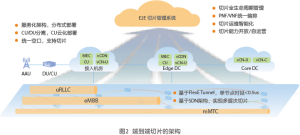
The end-to-end slice architecture implements E2E slice lifecycle management from the terminal to the core network, as shown in Figure 2.
The terminal percepts the slice: the 5G terminal presets/acquires the slice identifier, and associates with the specific application APP. When the application session is established, the slice identifier is uploaded, and the 5GC selects the corresponding slice to establish a session according to the user’s subscription slice information.
Wireless slice implementation: shared wireless slice, the user session selects the configuration parameter packet according to the slice identifier, and implements different air interface characteristics; the exclusive wireless slice forms a physically isolated slice by dividing different frequency bands.
The implementation of the bearer is as follows: 5G bearer SDN, virtual multiple virtual networks, differentiate forwarding performance requirements, and establish service-oriented connection tunnels on the corresponding virtual networks to form BN slices according to the requirements of scenario QoS and delay.
Core network segmentation: The 5GC network function of the multi-level DC is deployed on demand to form a CN slice. The user plane UPF can be flexibly deployed according to the scenario delay requirement, and the control plane NFs can be shared across slices.
Introduction of network intelligence
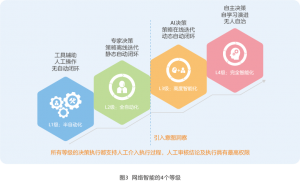
The cloud network convergence target architecture needs to be built on the basis of network intelligence. ZTE proposed four levels of network intelligence, as shown in Figure 3.
How to gradually introduce artificial intelligence into the network? ZTE proposes: unified orchestration, sub-domain management and control, and gradually realize network automation, intelligence, thick layout (business innovation), thin control (sub-domain management and control), which is conducive to building a healthy intelligent network ecology.
Mainly from the following aspects:
– Intelligent active data collection: Telemetry acquisition + AI intelligence;
– Thick choreography supports business innovation: business model + network atomic capability abstraction;
– Controller northbound interface standardization: hierarchical decoupling + simplified architecture;
– Hierarchical big data AI analysis: operational intelligence + network intelligence;
-Strategic stratified closed-loop automation: hierarchical closed loop + unified strategy.
Unified orchestration is the basis for rapid deployment of cloud network services. Through the unified orchestration, the cloud network is opened, the overlay network is built end-to-end, and the service is end-to-end; the network is SDNized, the controller is deployed in different domains, and the flexible connection is realized collaboratively. The edge nodes are flexibly distributed to realize the flexible construction of the on-demand network. Unified network management.
To achieve the unified arrangement of cloud network services, it is necessary to strengthen the management of the arrangement and enhance the ability of business innovation, and build the cloud network fusion orchestrator from the following aspects:
– Atomization of network capabilities, connected by point and surface;
– Componentization of business functions, custom development of APP cooperation;
– Compatible with controller/EMS, new and old network configuration linkage;
– The northbound interface is APIized to support Internet operations.
At the same time, ZTE actively combines AI technology with the telecom field. Based on the uSmartNet network intelligent series solution, ZTE provides complete data sensing, intent insight and intelligent analysis capabilities for telecom networks, helping telecom operators to adapt to the trend. Meet the challenges and create an AI network with the capabilities of “network autonomy, foreseeing the future, moving on demand, and smart operation”.
