


Last week, Huawei held the 16th Annual Analyst Summit in Shenzhen. A record 750 attendees and the company’s ambitious future plans are impressive. LC released a research report on the Huawei analyst summit, the main points are as follows.
Innovation 2.0
Huawei’s ambition is far more than the dominant position in the global telecom network equipment market. It challenges Apple and Samsung in the smart phone field, or challenges Cisco in the enterprise network market. Its new goal is to become a global leader in technology innovation and bring new to the market. Subversive technology. The company’s Innovation 2.0 strategy prioritizes vision-driven innovation rather than customer-driven innovation.
Safe question
In the Q&A session after the keynote speech, the security of the network infrastructure has emerged. Huawei’s rotating chairman Hu Houkun said that the security of communications infrastructure is a complex technical challenge that requires a coordinated, systematic approach to finding solutions. He pointed out the danger of incorporating these concerns into political issues and making decisions based on feelings rather than facts. Mr. Hu commented from the keynote speech that new cybersecurity standards must be developed and that verification mechanisms must be agreed upon by all vendors. He pointed out that Huawei and the EU are leading in this process, and he expects other suppliers and countries to join.
5G comes faster than expected
Huawei’s sales revenue in 2018 increased by 20%, but its operator business unit sales revenue decreased by 1.3%. The company expects the sector to resume growth in 2019, driven by 5G infrastructure investment. According to Mr. Hu, as of April 2019, Huawei participated in the construction of 40 5G networks, of which 6 are located in the Asia-Pacific region, 10 in the Middle East, and 23 in Europe. 5G deployment will directly affect the optical transceiver requirements of 2019. China Mobile will become the main users of these optical transceivers, and many of them will be manufactured by Huawei.
Optical Network 2.0
Huawei’s optical network strategy includes continuously improving fiber bandwidth utilization, optimizing product performance while reducing power consumption, from passive to predictive network operations and management. Artificial intelligence is expected to play a key role in future network management, but the current functions are some relatively basic functions such as delay maps and fault diagnosis.
Huawei’s latest oDSP technology (OptiXtreme) supports 200G DWDM CFP modules using G6 chips and 600G DWDM modules with H6 chips. Next-generation G7 and H7 oDSP chips (based on 7nm technology) will be launched in the second half of 2019 and the first half of 2020, respectively. The G7 will support pluggable modules with lower power consumption, and the H7 will be used for data rates of 800G per wavelength, as shown.
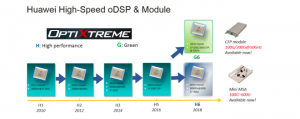
Increased fiber bandwidth utilization includes a transition to higher data rates, implementation through a new optimized oDSP chip, and more DWDM channels by extending the operating spectral range to the “Super C” band. With an internally manufactured EDFA amplifier and a widely tunable laser, network operation across the Super C band can be achieved, which helps to increase the spectrum of current fibers by 50% compared to the traditional C-band.
The number of optical devices and modules produced by Huawei is increasing, which is not good news for traditional optical devices and module manufacturers.
